


Nature - 2019 August - Vol 572 No 7771
Publisher: Nature
Format: Paperback
ISBN: 9770028083095
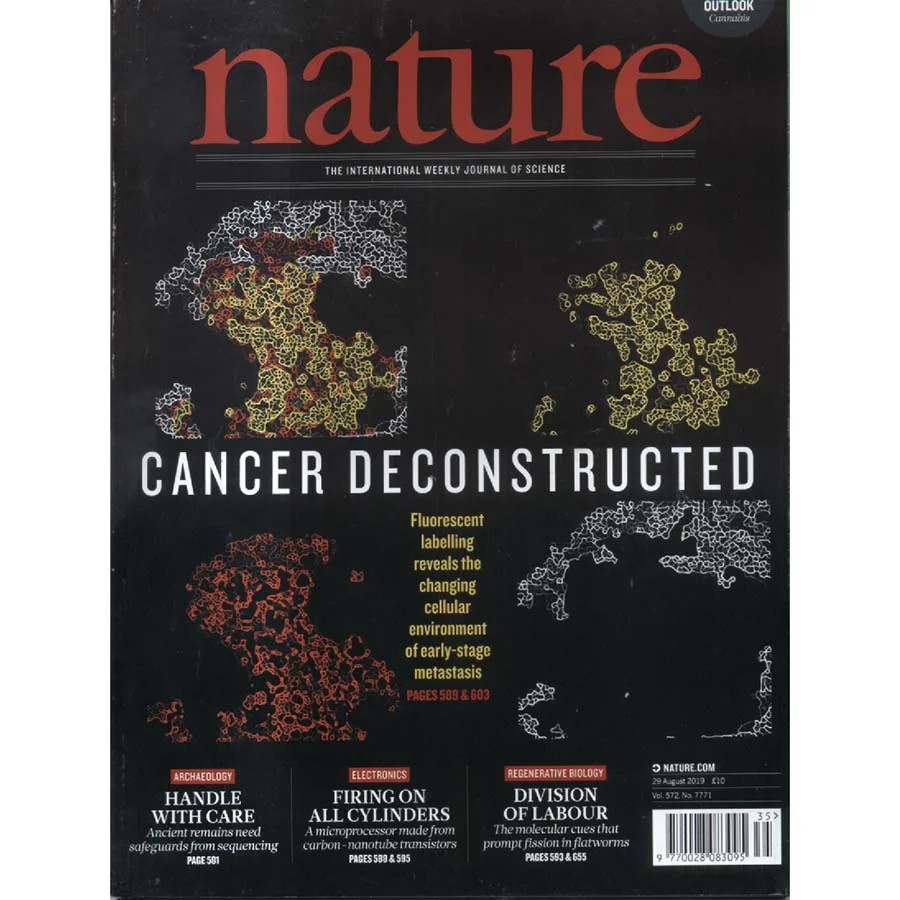
There are magazines that attempt optimism with soft colours and reassuring headlines. Nature – August 2019, Vol. 572 No. 7771 instead arrives in dramatic black and crimson beneath the title “CANCER DECONSTRUCTED”, looking less like a weekly science journal and more like the opening frame of an extremely expensive medical thriller.
The cover artwork is beautifully ominous: glowing fragmented cellular structures floating in darkness like abstract maps of a microscopic war zone. According to the featured research, fluorescent labelling reveals the changing cellular environment of early-stage metastasis. Which is an impressively calm way of saying scientists are now tracking cancer’s movements with astonishing precision while humanity collectively tries not to panic about what cells are doing when nobody is looking.
There is something wonderfully ironic about the phrase “Cancer Deconstructed”. It sounds almost architectural, as though metastasis were merely an overly ambitious renovation project requiring better diagrams. Inside, however, lies cutting-edge research into one of medicine’s most feared processes — the moment cells begin quietly abandoning their assigned duties and attempting territorial expansion.
And naturally, because this is Nature, the issue immediately pivots from cancer biology into archaeology, nanoelectronics, and regenerative flatworm research without missing a beat. Few publications can discuss ancient remains, carbon-nanotube transistors, and worm regeneration in consecutive pages while maintaining complete tonal confidence.
The archaeology feature, “Handle With Care”, is especially charming because it reminds readers that even ancient remains now require sophisticated genomic safeguarding protocols. Humanity spent centuries digging things up enthusiastically, only to realise later that perhaps extremely fragile archaeological material should not be treated like loose garden rubble.
Meanwhile, the electronics article on carbon-nanotube transistors quietly continues the late-2010s scientific tradition of building increasingly microscopic components for increasingly incomprehensible computational systems. Every year computers became smaller, faster, and more mysterious, while most people still struggled to remember passwords.
Then there are the flatworms. There are always flatworms. Science remains deeply fascinated by creatures capable of regenerating themselves in ways that seem unfairly effective compared to ordinary mammalian existence. Somewhere inside this issue, researchers are studying molecular cues guiding regeneration while human readers wonder why their own backs refuse to recover from sitting badly for twenty minutes.
One of the enduring pleasures of Nature is its extraordinary editorial restraint. “Fluorescent labelling reveals the changing cellular environment,” it notes politely, while readers stare at molecular maps that resemble cosmic battle plans. The magazine never sensationalises because reality, at this level, is already dramatic enough.
Owning a copy of Nature also projects a very specific intellectual atmosphere. It suggests someone deeply interested in cutting-edge science and perhaps capable of casually mentioning metastasis imaging techniques over coffee. Whether you actually read the detailed cellular analysis or simply admired the magnificent cover while feeling scientifically intimidated is entirely secondary.
This August 2019 issue now feels especially representative of the era: biology becoming increasingly visualised and data-driven, medicine entering astonishingly precise territory, and every branch of science accelerating simultaneously toward deeper complexity. The more humanity learned, the more existence resembled an interconnected system of microscopic negotiations and molecular accidents.
Condition is listed as Good, meaning this copy has survived the traditional hazards endured by elite scientific journals: overcrowded academic shelves, over-caffeinated office environments, backpacks full of postponed intellectual ambition, and years spent in piles labelled “important reading”.
A superb issue for science enthusiasts, medical-history readers, molecular biology obsessives, or anyone who enjoys magazines that casually combine metastatic imaging, ancient remains, nanotube electronics, and self-repairing worms into one beautifully intimidating package.
Keep browsing: See more Nature Journal books Other books by Nature
